ANDHAK, ANDHAKA – An asura (demon)

ANDHAK, ANDHAKA – An asura (demon)
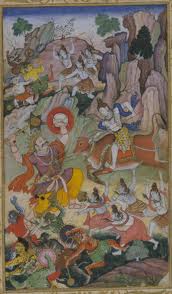
In one version of his birth Andhaka was a daitya (demon), born of Diti and KasSyapa. He had a thousand arms, a thousand heads, and thus two thousand eyes, hands, and feet (in another version, two thousand arms, two thousand legs). And even though he could see, it was said that he walked like a blind man. Andhaka means “blind” or “blind one.” In another version Andhaka was born from the love play (lila) of Parvati with her husband, Lord Siva. Parvati placed her hands over Siva’s eyes in jest, … Continue reading
ANASUYA – A heroine and role model for women

Anasuya was the wife of the sage Atri. As with all major figures in later mythol­ogy, her lineage was completely spelled out: granddaughter of Svayambhuva- Manu (Manu of his Yuga) and his wife Satarupa; daughter of Kardama-prajapati (progenitor of his age) and Devahuti. Anasuya (charity) was famous for the power of her austerities (tapas). Once Anasuya used her powers to bring rain when there had been a continuous drought; even the Ganga had dried up. Another time Anasuya changed ten days into night to help the gods. And when Sita … Continue reading

ANANTA – A celestial snake

ANANTA – A celestial snake

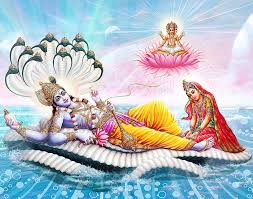
Ananta literally means “without end,” “infinite.” It was a descriptive term used of Vishnu and other gods. It was also used as a name of Vishnu’s serpent. Ananta was the giant serpent that floated upon the Milky Ocean and formed the bed for Vishnu as he slept during the involution of the universe (pralaya). Ananta (also known as Sesha) was the son of KasSyapa, the grandfather of all beings, by his wife Kadru. Other serpents, such as Vasuki, Takshaka, and Karkkotaka, were his brothers. Bala-Rama was a partial incarnation of … Continue reading

AMRITA – Immortal; immortality; a drink or food

In the Vedas, amrita was a characteristic or quality of a suitable offering in the fire sacrifices to the gods. Soma (the divine plant) had more amrita than other offerings. Later amrita (or amritam) was a substance produced by the Churning of the Milky Ocean (kshirabdhi-mathanam). There were different versions of this myth in the Mahabharata, the Ramayana, and the Puranas. According to one version the demons (asuras) had triumphed over the gods (devas), so the devas sought Lord Vishnu’s help. He told them about amrita and how it would … Continue reading

AMBARISHA – A king of the Ikshvaku dynasty

  Ambarisha, king of Ayodhya (birthplace of Rama), was one of the sixteen great kings who ruled Bharata (Marutta, Suhotra, Paurava, Sibi, Rama, Bhagiratha, Dilipa, Mandhata, Yayati, Ambarisha, Sasabindu, Gaya, Rantideva, Bharata, Prithu, and Parasu-Rama). In the Valmiki Ramayana there was a story about the theft of one of Ambarisha’s sacrificial cows by Indra. (In the Bhagavata Purana the theft was from King Hariscandra.) Ambarisha was forced to find a proper sacrifice to com­plete his rituals. So he bought the second of three sons, named SSunahsSepha, of a greedy brahmin … Continue reading

AIRAVATA

AIRAVATA

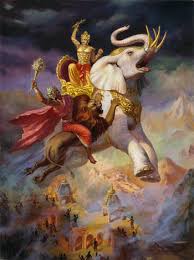
An elephant; the vehicle of Indra Airavata was the celestial elephant-king and the vehicle of Indra. Airavata was popularly known as the white elephant with wings. He was a descendant of the lineage of the sage KasSyapa. Airavata came from a maternal line (Kasyapa’s wife Krodhavasa, their daughter Bhadramata, her daughter Iravati, and then Airavata). Such parentage would certainly explain how it was possible for Airavata to be born as king of the elephants. In mythic time gods might simply change into an animal species with their spouses and have … Continue reading

AHALYA

AHALYA

The first woman; one of the five perfect women The story of Ahalya has as many dimensions as it has versions. She appeared in the epic Ramayana but was also projected back to the beginning of the creation of this age (yuga). One account stated that Brahma created her as the first and most beautiful woman on earth. Then he gave her to the rishi (sage) Gautama. In most tellings, the rest of her story illustrated how a perfect woman should behave under the worst of circumstances. The villain was … Continue reading

AGNI -A deva (god), god of fire

AGNI -A deva (god), god of fire

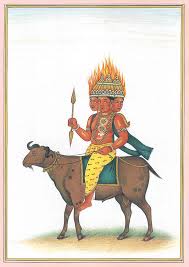
At his earliest appearance in the Rigveda, Agni was a complex deity. He was the fire of the sacred sacrifices that were the heart of Vedic religion as well as the central rituals of a seminomadic warrior culture. Agni was addressed as the deva who ruled earth, a third of the entire cosmos. Two other gods with the charac­teristic of fire formed a triad with Agni. The solar fire (deified by many names, especially that of Surya) was ruler of heaven; and the fire of the middle air, light­ning, was … Continue reading

AGASTYA, – AGASTI

AGASTYA, – AGASTI

A rishi (sage) who conquered the Vindhya mountains Agasti was mentioned in a hymn in the Rigveda dedicated to Mitra, a solar deity. That hymn said that two of the adityas, Mitra (comradeship) and Varuna (binder, “all-seeing”), placed their semen in a pot and set it before Urvasi, an unusually beautiful apsara (celestial maiden). Because she had aroused their desires, Mitra and Varuna cursed Urvasi to live on earth as the wife of the rishi Pururavas. Agasti (or Agastya) and Vasishtha were the sons born to her. Later versions expanded … Continue reading

ADITYAS – Devas (gods)

ADITYAS – Devas (gods)

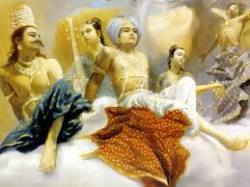
The sons born to Kasyapa-prajapati (a grandfather or procreator) and Aditi (mother of the gods) are called the adityas. In the hymns of the Rigveda, Aditi only had seven or eight children. But by the time of the Brahmanas there are twelve adityas: Dhata, Mitra, Aryaman, Rudra, Varuna, Surya, Bhaga, Vivasvan, Pusha, Savita, Tvashta, and Vishnu. They are among the most important of the earliest Vedic gods. This grouping could represent the twelve months, as they are celestial deities. In another context aditya (singular not plural) referred to the sun … Continue reading