ATRI – Son of Brahma

Brahma had six manasa-putras—sons created from his mind. Atri was one of them. The other five sons of Brahma are Marici, Angiras, Pulastya, Pulaha, and Kratu. Another version of the manasa-putras increased the number to seven, or the seven sages (sapta-rishis). Atri married Anasuya, and they had three sons, Soma (or Candra), Durvasa, and Dattatreya. Atri was also known as the author of a part of the Rigveda. His story is told at more length in the entry on Anasuya.
ATIBALA – Asamnyasin (world renouncer)

Yama took the form of a samnyasin and was the indirect cause for the death of Rama and Lakshmana. After Rama had killed Ravana in the Lanka war, the main reason for the incarnation of Vishnu as Rama was fulfilled. There needed to be a cause for Vishnu to return to Vaikuntha (his heavenly abode). Brahma asked Yama to go to see Rama. Yama went to see Rama in the guise of a samnyasin called Atibala and said that he had a secret to tell Rama. During their meeting with … Continue reading

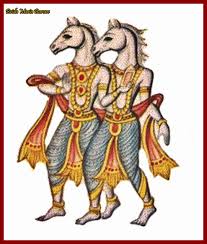
aSvins, aSvini-devas – The celestial Twins

aSvins, aSvini-devas – The celestial Twins

Satya and Dasra were popularly called the Asvins (possessors of horses) and were the physicians of the devas (gods). Their father was the sun, Surya. They were proud warriors who drove their chariot across the sky, paired as driver and fighter. They were associated with the goddess of the dawn, Ushas. It was their exploits against the demons Namuci and horse-headed Dadhyanc that proved them to be physicians of the gods. Twinning would pair them by association with all other twins in Hindu mythology: twin wives, the twin children of … Continue reading

aSvatthama, aSvatthama – A Kaurava general and a brahmin

Asvatthama became the commander-in-chief of the Kauravas when their great army had been reduced to three—plus the dying Duryodhana. Those three entered the camp of the Pandavas and slaughtered many heroes and their chil­dren. Five young sons of the Pandavas were beheaded and taken back to Duryo- dhana. Draupadi, wife of the Pandava brothers, wanted revenge, but she allowed her husbands a way out of slaying a brahmin. They only had to bring back the jewel Asvatthama wore. Bhima, Arjuna, and Krishna pursued Asvatthama and brought back his jewel to … Continue reading

aSva-medha – The horse (asva) sacrifice (medha)

aSva-medha – The horse (asva) sacrifice (medha)

A wild stallion was released by a warrior king to roam freely. The king or his general would follow the horse with an army and defeat in a battle any kingdom that the horse crossed that would not pay tribute and recognize the king’s sov­ereignty. There was a chance for great honor, but only a “world conqueror” (cakravartin) could complete such random warfare. At the end of the year the horse would be brought back to the king’s capital, where priests would sacrifice it in one of the most elaborate … Continue reading

ASURA – Demons

The term asura is so ancient that it has a separate mythology among the Aryans’ cousins in ancient Persia. In the Avesta, the word ahura (asura, Sanskrit) was a positive term that meant the gods. But the ahura were mainly gods of agrarian values, and the greatest ahura was Varuna, the god of the justice in the sense of cosmic order (rita) that a farmer could depend upon to reap what he had sowed. The original meaning of the word asura was “spiritual, divine.” Even in the Rigveda there was … Continue reading

aSikni – Wife of a prajapati and mother of many beings

Asikni must be ranked among the most fertile of all wives in Hindu myth. The myths only gave her this one dimension. Daksha, an alternative creator to Kasyapa, found that he could not create all of the species from his own mind. So he married Asikni and immediately begat five thousand Haryashvas, creatures who were to populate the earth naturally. But the old sage Narada, the deva-rishi (divine sage) with the golden words, shamed the Haryashvas with their igno­rance. He told them that they must first know the extent of … Continue reading

ASHTHAVAKRA – A sage

Sage Uddalaka’s daughter Sujata married his disciple Khagodara, and to them was born Ashthavakra. The word ashtha-avakra means “one with eight bends,” referring to his deformed body. There are two versions of how he acquired the eight bends. According to one version, once Khagodara was reciting holy mantras. Sujata sat beside him, but the baby inside her womb heard his father’s chants and said loudly that Khago- dara was chanting the mantras in the wrong way. Khagodara became very angry and cursed him to be born with a crooked body. … Continue reading

ARUNA – Charioteer of Surya

Aruna’s story must begin with an account of how he became the charioteer of the sun god, Surya. Aruna’s father was the famous KasSyapa-prajapati (grandfather of all creatures). Two of KasSyapa’s wives, Vinata and Kadru, pleased him so much that he granted each a boon. Kadru asked for a thousand naga (snake) sons, and Vinata wanted only two sons, more powerful than those of Kadru. So Kasyapa granted their wishes and went to the forest to practice austerities (tapas). After some time Kadru gave birth to a thousand eggs and … Continue reading