ARJUNA – A hero and warrior

ARJUNA – A hero and warrior
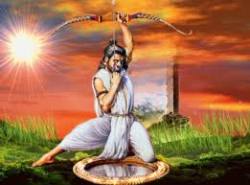
Arjuna’s story was one of the best known in Hindu mythology, yet it is fully intelligible only if one is familiar with the many other stories related to it. It is nested in or overlaps with the story of the great Bharata war, the story of Krishna, the story of Krishna’s mother, Kunti, and with the other larger stories, many of which are told in the Bhagavad Gita and the Mahabharata. Kunti received a mantra (magical formula) from the sage Durvasa as a five­fold boon so that she could become … Continue reading

ARAYANNA – The heavenly swans (hamsa)

The arayanna were described as having a heavenly abode on Manasasaras, one of the Himalayas. Ara denoted royalty. The swans did not like rain, so they came to earth when it rained in their heavenly abode and returned as soon as rain began on earth. Their parentage was traced to KasSyapa by his wife Tamra through her daughter Dhritarashthri. Valmiki’s Ramayana stated that this line­age alone gave the swan its divinity (devatva). Swans were at first black and white, according to a myth in the Uttara Ramayana, but pure white … Continue reading

ARA – Daughter of the sage Sukra

ARA – Daughter of the sage Sukra

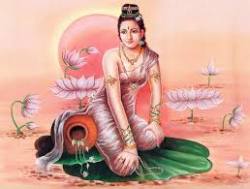
Her story was a warning to kings who abused their power, who did not live by the rules of civility, or who harmed the family of a brahmin. A haughty young king named Danda ruled a large kingdom that extended to the Himalayas. One day on a hunting expedition King Danda saw Ara, daughter of the great sage, Maharishi Sukra. In his lust he raped the young brahmin girl. Ara told her father, and he advised her to practice austerities (tapas). This must have been for purification, for it was … Continue reading

APSARA – A celestial being

APSARA – A celestial being

An apsara was a celestial damsel or nymph (devastri) found in Indra’s heaven, Devaloka. Apsaras were born at the Churning of the Milky Ocean. Another ver­sion, in the Manu Shastra, stated that these damsels were created along with the seven Manus. They were called wives of the gods and daughters of pleasure. The thirteen apsaras were also said to have come from the union of KasSyapa and Arishta. The apsaras were known as heavenly charmers (as was Urvasi) of heroes and temptresses (as were Menaka and Rambha) of sages. Their … Continue reading

APALA – A daughter of the sage Atri

A story in the Rigveda says that Apala was abandoned by her husband when she came down with leprosy. She began living in the ashram of her father Atri and did austerities (tapas) to please Indra. One day when she was coming back from her daily rituals beside the river, she happened to taste soma (amrita) that was to be offered to Indra. Perhaps she could be healed by this magical ambrosia of the gods, or she could even gain immortality. But when Indra appeared, she immediately gave the soma … Continue reading

ANJANA – A monkey; mother of Hanuman

Once SSiva and Parvati were playing in the woods in the form of monkeys. Par- vati became pregnant. The fetus was given to Vayu, the wind god. Vayu gave it in turn to Anjana who was doing austerities (tapas) at that time in order to obtain a son. Thus, Kunjara, the monkey chieftain, and Anjana gave birth to Hanuman. In her previous birth Anjana was a goddess named Punjikastala (also known as Managarva). She was born as a she-monkey, Anjana, as a result of a curse. She was redeemed from … Continue reading

ANI-MANDAVYA – A sage

ANI-MANDAVYA – A sage

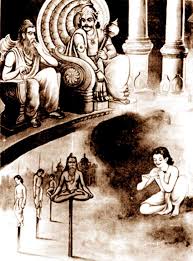
Mandavya was a sage who was doing penance at his hermitage (ashram) when sev­eral thieves ran past being chased by the king’s men. The thieves left the stolen property near Mandavya and ran away. The king’s men found Mandavya with the stolen property and took him before the king. Since he did not answer the ques­tions put to him, Mandavya was condemned to death—along with the thieves, who were finally caught. They were all pierced through with a trident. The thieves died, but Mandavya stayed alive. After some time SSiva … Continue reading

ANGIRAS – A Sage

ANGIRAS –  A Sage

Angiras appeared in many roles, some contradictory. The Rigveda called him the first of the fire-gods. As such he was a mediator between gods and men. At times he appeared as a maharishi, a composer of many Rigvedic hymns to the gods. He was also a prajapati, or progenitor of humankind. As such his origin or lineage was important, at least for later mythology. He was said to be born from the mind of Brahma, as were five other sages: Marici, Atri, Pulastya, Pulaha, and Kratu. There was a quite … Continue reading