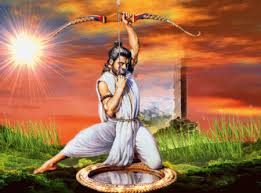
GANDIVA – The bow of Arjuna

The distance between gods and heroes in Puranic mythology was not very great. Divine weapons, like the Gandiva, the great bow of Brahma, could be given to mere mortals, since the mortals were so often partial divine incarnations or from mixed marriages between gods and mortal women. Such was the case with Arjuna who did not have a human father, as he was born of Indra (god of war) and Kunti. The Gandiva was made by Brahma. He kept the Gandiva for 1,000 years and then passed it on to … Continue reading
GANDHARVAS – A class of devas (gods)

This class of gods appeared first in the Vedic period. They were sky beings, asso­ciated with the preparation of soma. The Atharvaveda said that there were 6,333 gandharvas. They liked mortal women and sported with them, using their pow­ers to shape-shift and fool all but the most disciplined of wives. There were, however, a number of great heroines whose austerities (tapas) were a match for the magic powers (siddhis) of the gandharvas. In later mythology they were said to be children of the progenitor, or grandfather, named Kassyapa-prajapati, by his … Continue reading

DURYODHANA – The eldest of the Kaurava brothers and an arch villain

Duryodhana’s birth was a miracle from Siva, assisted by a blessing from Vyasa. (See account under Dhritarashthra.) Duryodhana was raised in the palace of King Pandu, who reigned because his blind brother Dhritarashthra was disqualified by his infirmity. When Pandu died, his oldest son Yudhishthira became king. Dury- odhana and his ninety-nine brothers had trained in the martial arts with theirfive cousins, the sons of Pandu, or Pandavas. However, jealousy grew into hatred, and Duryodhana turned into one of the arch villains of Indian literature and myth. The sheer length … Continue reading

DHRITARASHTHRA – Son of Ambika and the sage Vyasa (credited with receiving the Vedas)

DHRITARASHTHRA – Son of Ambika and the sage Vyasa (credited with receiving the Vedas)

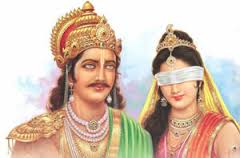
The lunar dynasty was in danger of dying out. Dhritarashthra’s life story is an illustration of just how weak dharma (truth, righteousness, religion) had become on earth. Dhritarashthra was the king under whose rule the great Mahabharata war would be fought. Evil could not be reversed as the great royal lineage fought amongst itself. Dhritarashthra’s conception compromised the great sage Vyasa who was not married to his mother, his resulting blindness disqualified him from being cho­sen king until there was no other choice, and his own past karma placed him … Continue reading

DEVAKI – Daughter of a Yadu leader and mother of Sri Krishna

DEVAKI – Daughter of a Yadu leader and mother of Sri Krishna

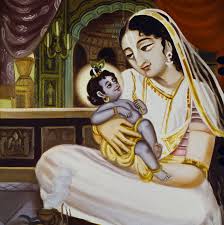
Devaki was said to be the rebirth of Aditi, the mother of the devas and wife of Kas’yapa-prajapati. She was more famous as the mother of Sri Krishna. (Vishnu pulled two hairs from his head, one white, another black, and implanted them in the wombs of Rohini and Devaki. Each divine fertilization became a full incarnation of Vishnu.) One account stated that Devaki held a svayamvara (the self-selection of her husband by a ksatriya princess) in which she chose Vasudeva. At their marriage a voice from heaven announced that her … Continue reading

CITRANGADA – (1) The third wife of Arjuna

This myth is nested within several other myths within the Mahabharata. There was a devout worshipper of (Siva who has been promised a son but could not pro­duce one himself. His daughter, Princess Citrangada, succeeded in bearing a son by the hero Arjuna, who is given this reason for leaving his joint wife Draupadi (taking another wife in order to fulfil a boon granted by Siva). Previously, Prince Arjuna was forced to leave home because he broke an agreement that the five brothers (the Pandavas) made in order to have … Continue reading

CANDRA – The moon, a deva

In the Vedic period Candra, the moon, and Soma, the entheogenic plant, were connected by associations (bandhus) in the early hymns. However, Candra was not one of the adityas with Surya (the sun), but was one of the eight Vasus with Vayu (the wind). By the Puranic period Candra’s very essence had changed to that of just another Vedic deity to use as a bad example in the self-elevation or pride of medieval priests. Candra’s highest birth in the myths was as an emergence from the Churn­ing of the Milky … Continue reading

BHUMI -The goddess of earth

Bhumi (the earth) was a Puranic addition to the Hindu pantheon. There are a number of versions of her birth, and her children had so many different gods and demons as fathers that another myth had to provide a curse from Parvati to explain this flaw in her character. Some of the versions of Bhumi’s birth in the Puranas involved a physicalearth that then became a goddess. But in others she is the daughter of Brahma. In one version of the first kind, during the period of floods, the earth … Continue reading

bala-rama, balarama, balabhadra-rama – Elder brother of Krishna and an avatara of Vishnu

bala-rama, balarama, balabhadra-rama – Elder brother of Krishna and an avatara of Vishnu

This myth is nested within the great myth cycles of Lord Vishnu and Shri Krishna. Bala-Rama was involved in many episodes as an adoring, supportive older brother of Krishna. It was a role deserving of a divine lineage, demonstrat­ing the kind of person who deserved to be near so great an incarnation as Krishna, and how important it is to live one’s own dharma (duty). Bala-Rama’s birth was particularly miraculous. On the day of the marriage of the Yadava king Vasudeva to Devaki, a voice was heard from the sky … Continue reading

ARJUNA – A hero and warrior

ARJUNA – A hero and warrior

Arjuna’s story was one of the best known in Hindu mythology, yet it is fully intelligible only if one is familiar with the many other stories related to it. It is nested in or overlaps with the story of the great Bharata war, the story of Krishna, the story of Krishna’s mother, Kunti, and with the other larger stories, many of which are told in the Bhagavad Gita and the Mahabharata. Kunti received a mantra (magical formula) from the sage Durvasa as a five­fold boon so that she could become … Continue reading