DEVAKI – Daughter of a Yadu leader and mother of Sri Krishna

DEVAKI – Daughter of a Yadu leader and mother of Sri Krishna
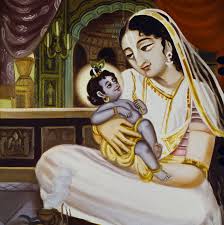
Devaki was said to be the rebirth of Aditi, the mother of the devas and wife of Kas’yapa-prajapati. She was more famous as the mother of Sri Krishna. (Vishnu pulled two hairs from his head, one white, another black, and implanted them in the wombs of Rohini and Devaki. Each divine fertilization became a full incarnation of Vishnu.) One account stated that Devaki held a svayamvara (the self-selection of her husband by a ksatriya princess) in which she chose Vasudeva. At their marriage a voice from heaven announced that her … Continue reading
DEVA, DEVAS; DEVI, DEVIS – A god, deity; one of a class of celestial gods

In Hinduism the divine may be viewed as having form (murti) and attributes (gunas) or being without any form or qualities at all (nirguna). The former per­spective was for those with little understanding and in need of every hint possi­ble. Myths about devas added shape and form to the divine mystery. The word deva is derived from the word for light, since a deva is one who shines forth. It was said in some sacred texts that it was related to the word for play as well. The word is … Continue reading

DATTATREYA – A sage

DATTATREYA – A sage

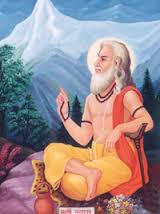
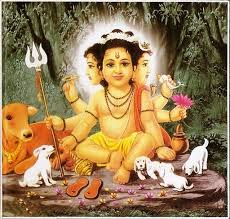
Dattatreya had wonderful parents: the sage Atri and his wife Anasuya. Dat­tatreya was an incarnation of Vishnu according to some Puranas. Why did Lord Vishnu incarnate as Dattatreya? The Brahmanda Purana traced the story back to a hermit named Ani-Mandavya who meditated under a vow of silence. In pursuit of robbers who dropped their loot beside Ani-Man- davya, the king’s guards bound the yogi and dragged him off to prison. The king ordered his execution on a trident, and Ani-Mandavya suffered but did not die. Adding another element of the … Continue reading

DASARATHA – A king, father of Sri Rama

DASARATHA – A king, father of Sri Rama

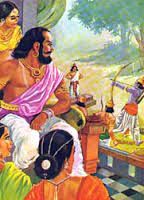
To be so great a figure as to have a god born as one’s son, one must have a dis­tinguished lineage, excellent karma (based on what one had done in past lives), and a record of devotion and service to the gods. All of these elements were pro­vided in the various episodes about King Das’aratha. Various compositions and retellings of the Ramayana nest one myth within another, to the great delight of Indian audiences throughout the centuries. There were enough blessings and cursings, magical powers, and divine visitations reaching into … Continue reading

DAMAYANTI – Daughter of King Bhima of Vidarbha and wife of Prince Nala

DAMAYANTI – Daughter of King Bhima of Vidarbha and wife of Prince Nala

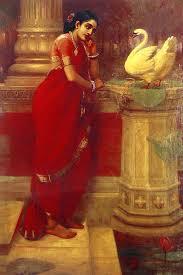
Damayanti was born from the blessing of her childless parents by the sage Dama. She grew into a beauty whose fame reached the attention of Prince Nala. Damayanti also knew of this handsome prince from those divine messengers, the swans. The two fell in love without even meeting. King Bhima announced a svayamvara (a ksatriya custom in which the princess could select her own husband). Nala set out for the kingdom of Vidarbha with the hope of being chosen by Damayanti but was met by four gods—Indra, Agni, Varuna, and … Continue reading

DALBHYA – A sage

This is an example of a myth about a priestly curse that explains the bad fortune of a king and a kingdom. Such a myth served as an advertisement of the powers (siddhis) of brahmins and their ability to bless or curse. This late story in the Vamana Purana referred back to the setting of the great war told in the Mahab- harata and why King Dhritarashthra’s kingdom was destroyed. The listeners would appreciate an addition to the many other reasons that they already knew from the episodes of the … Continue reading

DAKSHA – A prajapati (creator or progenitor)

In the Rigveda (2:27:1) Daksha (ritual skill) was one of the six adityas, deities related so closely to Vedic sacrificial ritual that they may be called personifica­tions of its logic and method. During the Vedic period the six expanded to twelve, with Daksha always among the most important. Ritual skill in sacrifi­cial magic-science was then central to Vedic and Brahmanical religion and mythology. In the great Hindu epics, references to Daksha abound, as numerous versions of his myth were recorded without much regard for consistency. Daksha was born from the … Continue reading

DAKINIS – Class of women who are proficient in magic

DAKINIS – Class of women who are proficient in magic

Women magicians were not given much of a role in nonsectarian Hindu mythol­ogy. The magicians known for their country and mentioned in the Mahabharataas the Kshudrakas were one exception. They came to the aid of Duryodhana and the Kauravas. Bhishma even had the Kshudrakas attack Arjuna. In another incar­nation myth most of the Kshudrakas were exterminated, along with the ksatriyas, by the brahmin-warrior Parasu-Rama (Rama-with-the-ax, an avatara). Later in (Sakta myths the dakinis were transformed into the blood drinkers (ashrapas) of Kali and were her fiendish helpers, who feed on … Continue reading

DADHICI OR DADHICA – A sage

DADHICI OR DADHICA –  A sage

Dadhici had been made from the essence of the world by his father, the great ascetic Bhrigu. He too became an ascetic and engaged in severe tapas (austeri­ties). Indra became afraid that his position of Indrahood (as king of the gods) was threatened by a yogi with such power (siddhi). So Indra sent Alambusha, one of his apsaras (celestial damsels), to deter Dadhici from his austerities. Watching the dance of Alambusha at his hermitage, Dadhici had a seminal discharge, which fell into the river Sarasvati. Sarasvati gave birth to a … Continue reading

CYAVANA – An asura (demon) sage

Cyavana was a son of the great teacher and priest of the demons, Bhrigu. Cya- vana had become a great magician like his father, but he had grown old and blind. The Asvins, the Divine Twins, cured Cyavana of both his old age and blindness. After getting back his youth, Cyavana was extremely happy with theAsvins, who had won their fame as physicians to the gods. Now Indra had banned the Asvins from partaking of soma, the celestial drink. Cyavana prom­ised that he would help them get soma, even if … Continue reading