CUDALA – Aqueen and great scholar

Queen Cudala’s accomplishment was placed long ago in the first Dvapara yuga of the seventh manvantara (world cycle). Perhaps that placement in an age of greater spiritual potential was why ks’atriyas were able to achieve great powers (siddhis) without mention of a brahmin teacher and a woman could learn faster than her husband. It seemed also to be a time when humans did not wish to yield to the temptation of calling for help from a god. An alternative interpretation is that we are dealing with an anti-priestly myth with … Continue reading
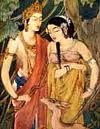
CITRASENA – A gandharva (celestial musician)

Citrasena had many roles in the Puranic and Epic literature. While flying overhead in his celestial chariot, Citrasena accidentally spat on the sage Galava, who complained to Krishna, who in turn vowed to kill Cit- rasena before sunset. The good old sage Narada telepathically learned of all this and told Citrasena. So Citrasena’s two wives, Sandhyavali and Ratnavali, made a firepit before the abode of Subhadra, wife of Arjuna and sister of Krishna. They planned either to win her help or to die with their husband on his funeral pyre. … Continue reading

CITRARATHA – Agandharva (celestial musician)

CITRARATHA – Agandharva (celestial musician)

In the Mahabharata while the Pandavas were walking in the forest after killing the demons Hidimbha and Baka, they heard a sound in the river nearby of some­body taking a bath. Arjuna went to see who was taking a bath at night. He saw the gandharva king Citraratha and his wife Kumbhinasi bathing together. It was the only moment that it was possible for a human to see a gandharva—at twi­light when it was between night and day. Citraratha was furious at having a human spy on his privacy and … Continue reading

CITRANGADA – (2) The daughter of Visvakarma, the celestial architect

One day while she and her friends were taking a bath in a forest pond, Cit- rangada saw Prince Suratha, son of Sudeva, walking by. She recognized that Suratha was in love and that she would give herself to him. Her friends tried to restrain her impulse but could not. Learning of this, her father, Visvakarma, cursed her that she would never marry. Citrangada fainted, but her friends believed that she was dead and took her to the cremation ground beside the Sarasvati River. They left her there while they … Continue reading

CITRANGADA – (1) The third wife of Arjuna

This myth is nested within several other myths within the Mahabharata. There was a devout worshipper of (Siva who has been promised a son but could not pro­duce one himself. His daughter, Princess Citrangada, succeeded in bearing a son by the hero Arjuna, who is given this reason for leaving his joint wife Draupadi (taking another wife in order to fulfil a boon granted by Siva). Previously, Prince Arjuna was forced to leave home because he broke an agreement that the five brothers (the Pandavas) made in order to have … Continue reading

CITRALEKHA – Daughter of the demon Bana

This little story has great popular appeal. One even finds it alluded to or even added as a scene within modern Indian films or video serials. According to the Bhagavata Purana Chitralekha had an unusual ability to draw portraits. She drew one from an account of a dream that Usha, a princess, gave. The portrait actually was the picture of someone whom Usha was yet to meet. Usha fell in love with the portrait and then discovered that it was Aniruddha, grandson of Krishna. Later, when Aniruddha was brought to … Continue reading

CITRAKETU – A king who longed for a son

This nested myth within a myth begins with a king and queen being granted a child; they then gain the blessing of becoming gandharvas (celestial musicians), but the story ends with the king cursed to become a demon. According to the Bhagavata Purana King Citraketu and his queen had been childless for many years before they received a blessing from the sage Angiras. From that blessing came a son. However, not long after the infant died. With great sorrow Citraketu took the body of his son to Angiras. Angiras was … Continue reading

CHAYA – A goddess (a replica of a goddess; literally, “shade,” or “shadow”)

The goddess Samjna created her replica, Chaya, in order to fool her husband, the sun (Surya). After having three children by Surya (Manu, Yama, and Yami), Samjna could no longer stand the heat of his affections. So she created Chaya to take her place. Things went well for a while, and Chaya gave birth to Sani (the planet Saturn), a Manu (first human of a cosmic age) known as Savarni, and a river goddess, Tapati. Chaya treated her own children so well that Yama, who had been fooled as completely … Continue reading

CATUR-VARNA (CATURVARNYAM) – The four (catur) castes (varna)

The brahmin, ksatriya, vaisya, and sudra castes originated from the body of Brahma, according to the Rigveda. The later purusha (cosmic man) myth posited their origin from the self-sacrifice of the “first man,” god creating by self-divi­sion. By the late Vedic period four castes, instead of three, and a definite hierar­chy with the brahmins at the top had been firmly established. The first three castes were twice born, leaving the sudras without a second or ritual birth. Therefore, sudras could be not eligible to study Sanskrit or learn the Vedas … Continue reading